Good news! All the patterns from the "Fascinating Lace" workshop are now available at verenaknitting.com. If you are already a subscriber you'll find them all, for free, by clicking your Bonus Patterns link. They are also available for individual sale in our Pattern Shop.
I've been neglecting the Orenburg Shawl to knit up a swatch in answer to a question in our Forums. Since it relates directly to lace I've decided to share the results with everyone.
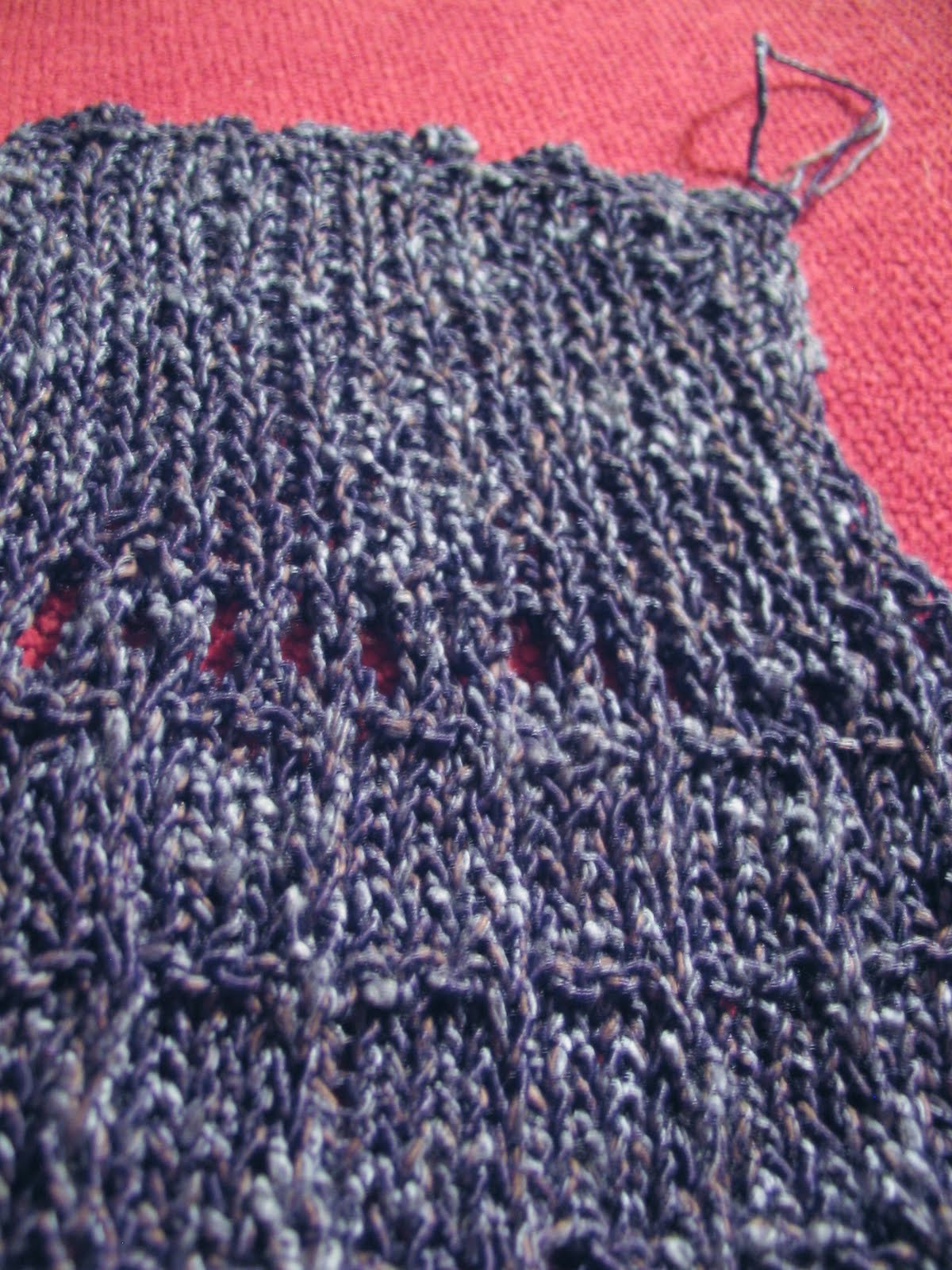
The pattern is Moody Blue from our Summer 2009 issue. It's an all over lace pattern and the decreases were causing the fabric to slant dramatically on one side:
I knit, frogged and re-knit several times, trying out different tactics for working the decreases and the result was always the same. I then decided to work the pattern without any decreases to see what that looked like and I got the smaller swatch below:
Both edges slant at almost the same angle. So even though the straight right edge of the decreased swatch seemed like a regular selvadge it was clearly different than the right edge of the un-decreased pattern. The left edge is slanted but not as dramatically as the one with the decreases in it.
Further research reveals that this is the result of all the decreases being worked in the same direction, in this case a PSSO. Seams will keep a garment knit in an all-over lace pattern that tends to bias like this from twisting around. I would be careful to pin the seams together and make sure that the pieces are properly matched up on both sides before sewing.
While we're here, some general tips for working decreases in all over lace patterns seem in order. The pattern here includes instructions for Full Fashion decreases, which can be worked more easily by keeping the first and last few stitches in stockinette and working the decreases in those. Alternatively, since the wrong side rows are knit across in purls, working the decreases on that side will prevent confusion with the yarn over/decreases of the stitch pattern itself. I tried several ways, in one case eliminating a yarn over from the stitch pattern rather than working two decreases and a yarn over right at the edge. This is a perfectly legal way to work a decrease in lace provided you can keep track of what you are doing well enough to maintain the pattern itself and make the decreases correctly.
Stay tuned for our regularly scheduled programming: More adventures in Orenburg Lace.
Tuesday, June 22, 2010
Monday, June 14, 2010
Enmeshed in Lace
This past weekend, subscribers to our free Newsletter were treated to a flip book of the lace patterns from our "Fascinating Lace" workshop . I know many people have been looking for these patterns and we promised to have them up on the site. Technical difficulties have delayed our putting them there, so for those of you who haven't subscribed to the Newsletter (did I mention it's free? You never know what goodies will appear in your inbox with this one!) I'm posting a link to the Flip Book, where you can see the designs. The patterns will be available shortly on our website.
If you're planning on knitting any of them, please find us in our Lace KAL on Ravelry. There's no time limits or pressure, just support and camaraderie. I'm forging ahead with the Orenburg Shawl (more on that soon...) but you're welcome to knit any of the many lace patterns in our spectacular Summer Issue. See you there!
Thursday, June 10, 2010
Wow, that first step is a doozy! Important safety tip: Pay careful attention to the difference between our standard "K2Tog" symbol, a right triangle in the lower right of the square (seen here next to the circles representing yarn overs) and the design specific symbol (seen as the last stitch in the second row from the bottom.) This is also a right triangle in the lower right of the square, but it is enclosed within another square inside the block. It's easy to see at this magnification, but easy to miss in the heat of knitting!
This yarn is like knitting with a filament of cloud. Of course the color reinforces that impression, but I'm sure it would be just as heavenly in any color you can get your hands on.
Stay tuned for more adventures in Orenburg lace. I'm looking at working 3 charts simultaneously for the next several hundred rows, so I'm off to buy some more row counters.
This yarn is like knitting with a filament of cloud. Of course the color reinforces that impression, but I'm sure it would be just as heavenly in any color you can get your hands on.
Stay tuned for more adventures in Orenburg lace. I'm looking at working 3 charts simultaneously for the next several hundred rows, so I'm off to buy some more row counters.
Tuesday, June 8, 2010
The Summer of Lace
I can't wait to start knitting this shawl. I've always been fascinated with Orenburg lace, but never gotten up the gumption to knit anything. Finally, a perfect Lace storm seems to be brewing around me: the structure is unlike anything I've knit before, the charts are daunting, the yarn, Filatura di Crosa Superior, is exquisite. I'll be documenting my adventure with this lovely pattern in this space and sharing ongoing comments in the LACE KAL in the Verena Group on Ravelry. I hope some of you will join me in knitting this wonderful pattern, or any of the other lace patterns from Verena.
I know that many of you have been looking for the patterns featured in our Fascinating Lace Workshop. They will be available in the Subscriber Bonus area on our website by this weekend.
Friday, May 21, 2010
Swatcheroo the First! #47 Ufizzi (and bonus )
Introducing: Swatcheroo, wherein I seek out alternative yarns for Verena Knitting patterns designed on yarn that is unavailable in North America, swatch the stitch patterns in question and discuss the results. I hope this will be helpful for readers of our North American edition who want to knit one of these patterns and may not be sure which yarn to choose.
My first pattern is #47 Ufizzi from the Spring 2010 issue. I have two skeins of yarn from Berocco, Ultra Alpaca Light, a blend of 50% Super Fine Alpaca and 50% Peruvian Wool, and Seduce, a blend of Rayon, Linen, Silk and Nylon. Actually Seduce is not a blended yarn in the usual sense, there is a core of 3 strands wrapped by a 4th (nylon) strand. The yarn has an interesting weight and texture to it and once it was in my hand I decided to try it out on another pattern as well, but more on that later. I thought this would be a potential alternative for those who live in warmer climates and don't want to even think about wool during the summer. It knit into a more open fabric than the wool.


I like this yarn. The 3 core yarns are different colors so they create a tweedy effect as they peek through the black binder. The binder itself is shiny and gives the knitted fabric a sheen I failed to capture in the picture below. It makes a light fabric with nice drape that would be comfortable in warmer temperatures as well as air conditioned spaces. On #6 needles I got a gauge of 6.4 stitches to the inch in the textured pattern, so I'd need to adjust my needle size down to get the correct gauge, but not so much that it would significantly change the nature of the fabric produced.
The Ultra Alpaca Light is closer to the original yarn recommended which is 100% wool. It also renders a lovely drapey fabric, the halo of the alpaca and the loftiness of the yarn makes the overall effect more closed than the Seduce.
The colorway is less variegated than the Graphite, but it's a lovely shade of gray. This yarn would be a good substitute for the original yarn recommended in the magazine. I got a gauge of 6.26 stitches per inch on #6 needles in the textured pattern. The given gauge is 6 stitches to the inch, so a small adjustment of needle size would give me the correct gauge.
And now for the bonus Swatcheroo: once I looked at the Seduce and compared it to some of the other patterns I was looking at, I noticed that it was a potential substitute for #36, Orient Point. This is obviously a different color than we feature in the magazine, but I think that this yarn, which is available in many lovely colors would make a good substitute for this pattern. The lower segment, with two lace panels, is much wider in my swatch than the upper segment with two cable panels. The average gauge I achieved with #6 needles is 6.5 stitches to the inch. The gauge for this pattern is 6.25, so this would certainly be easy to adjust for.
This concludes my first Swatcheroo. If anyone has suggestions for patterns that you would like to see me discuss in this way, please feel free to leave your suggestions in the comments and I'll be happy to see if I can work out some substitutes in this space.
My first pattern is #47 Ufizzi from the Spring 2010 issue. I have two skeins of yarn from Berocco, Ultra Alpaca Light, a blend of 50% Super Fine Alpaca and 50% Peruvian Wool, and Seduce, a blend of Rayon, Linen, Silk and Nylon. Actually Seduce is not a blended yarn in the usual sense, there is a core of 3 strands wrapped by a 4th (nylon) strand. The yarn has an interesting weight and texture to it and once it was in my hand I decided to try it out on another pattern as well, but more on that later. I thought this would be a potential alternative for those who live in warmer climates and don't want to even think about wool during the summer. It knit into a more open fabric than the wool. 

I like this yarn. The 3 core yarns are different colors so they create a tweedy effect as they peek through the black binder. The binder itself is shiny and gives the knitted fabric a sheen I failed to capture in the picture below. It makes a light fabric with nice drape that would be comfortable in warmer temperatures as well as air conditioned spaces. On #6 needles I got a gauge of 6.4 stitches to the inch in the textured pattern, so I'd need to adjust my needle size down to get the correct gauge, but not so much that it would significantly change the nature of the fabric produced.
The Ultra Alpaca Light is closer to the original yarn recommended which is 100% wool. It also renders a lovely drapey fabric, the halo of the alpaca and the loftiness of the yarn makes the overall effect more closed than the Seduce.
The colorway is less variegated than the Graphite, but it's a lovely shade of gray. This yarn would be a good substitute for the original yarn recommended in the magazine. I got a gauge of 6.26 stitches per inch on #6 needles in the textured pattern. The given gauge is 6 stitches to the inch, so a small adjustment of needle size would give me the correct gauge.
And now for the bonus Swatcheroo: once I looked at the Seduce and compared it to some of the other patterns I was looking at, I noticed that it was a potential substitute for #36, Orient Point. This is obviously a different color than we feature in the magazine, but I think that this yarn, which is available in many lovely colors would make a good substitute for this pattern. The lower segment, with two lace panels, is much wider in my swatch than the upper segment with two cable panels. The average gauge I achieved with #6 needles is 6.5 stitches to the inch. The gauge for this pattern is 6.25, so this would certainly be easy to adjust for.
This concludes my first Swatcheroo. If anyone has suggestions for patterns that you would like to see me discuss in this way, please feel free to leave your suggestions in the comments and I'll be happy to see if I can work out some substitutes in this space.
Sunday, May 16, 2010
Devilish Details
Just a quick note to let everyone know that the missing Oahu chart is available on our Pattern Corrections page.
The enlarged chart for the Orenburg shawl will be posted shortly.
For readers of Anna Crafts magazine, the Spring 2010 issue will be available digitally. Both Digital and Print subscribers will be able to access their issues on the Anna Crafts website by the end of May. If you are a subscriber and have difficulty logging in and seeing your issues after May 31st, please give us a call and we'll address any remaining problems individually.
The enlarged chart for the Orenburg shawl will be posted shortly.
For readers of Anna Crafts magazine, the Spring 2010 issue will be available digitally. Both Digital and Print subscribers will be able to access their issues on the Anna Crafts website by the end of May. If you are a subscriber and have difficulty logging in and seeing your issues after May 31st, please give us a call and we'll address any remaining problems individually.
Wednesday, May 5, 2010
Tropicalismo! Summer Pattern Preview
Tropicalismo!
Summer's blown into the Northeast early with a blast of tropical air. The calendar says it's two months until the solstice, but the thermometer has another idea. Time to plan your summer projects! I thought I'd enable by offering a peek at some of what Verena's got in store for our Summer issue.
Photographed in beautiful Tulum, Mexico, on the Mayan Riveria, the relaxed spirit of the tropics prevails.
Lace or color, casual or composed, this is just a glimpse of what's coming in our next issue.
Subscribe to:
Posts (Atom)