Wow, that first step is a doozy! Important safety tip: Pay careful attention to the difference between our standard "K2Tog" symbol, a right triangle in the lower right of the square (seen here next to the circles representing yarn overs) and the design specific symbol (seen as the last stitch in the second row from the bottom.) This is also a right triangle in the lower right of the square, but it is enclosed within another square inside the block. It's easy to see at this magnification, but easy to miss in the heat of knitting!
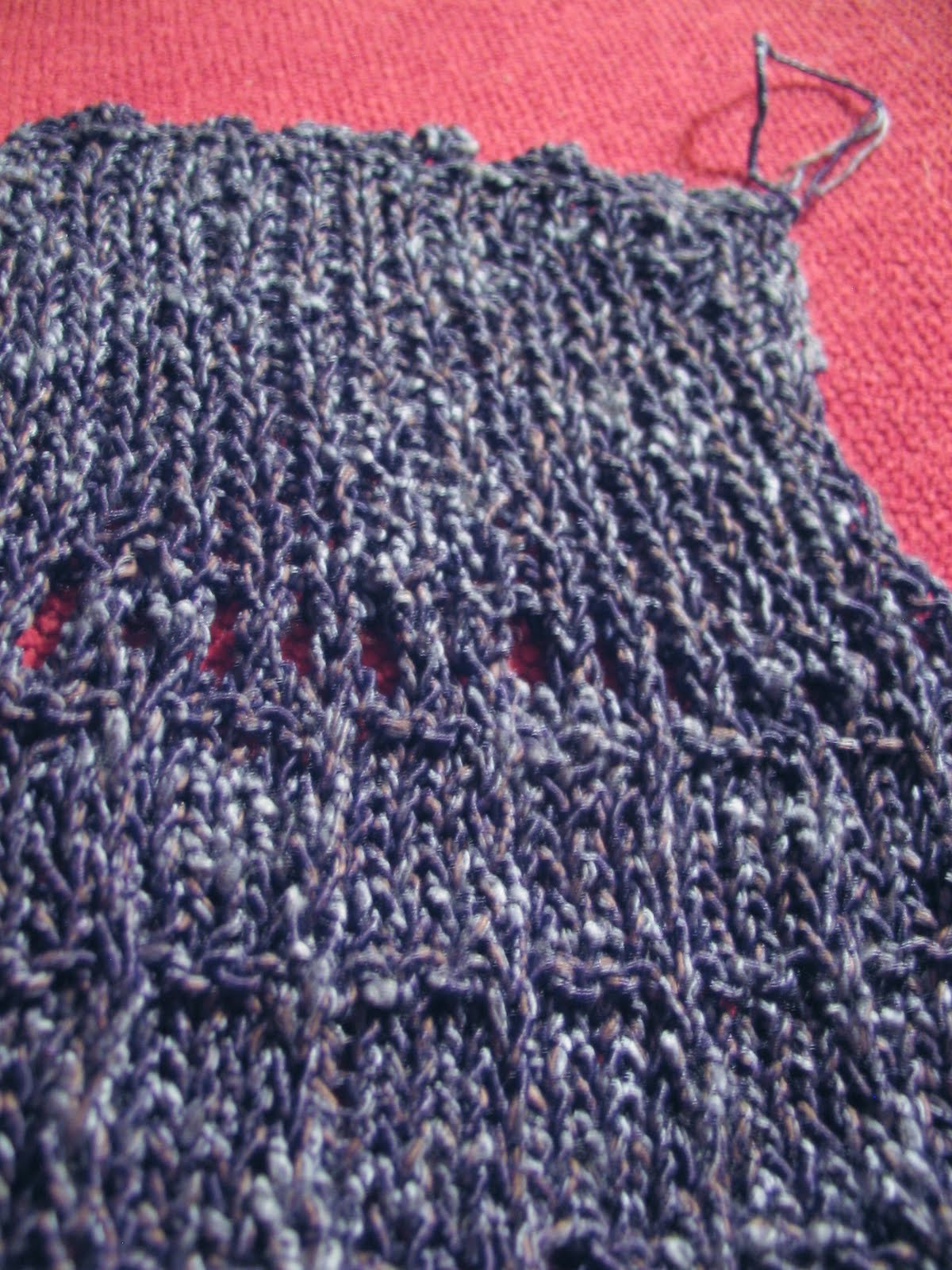
This yarn is like knitting with a filament of cloud. Of course the color reinforces that impression, but I'm sure it would be just as heavenly in any color you can get your hands on.
Stay tuned for more adventures in Orenburg lace. I'm looking at working 3 charts simultaneously for the next several hundred rows, so I'm off to buy some more row counters.
Thursday, June 10, 2010
Tuesday, June 8, 2010
The Summer of Lace
I can't wait to start knitting this shawl. I've always been fascinated with Orenburg lace, but never gotten up the gumption to knit anything. Finally, a perfect Lace storm seems to be brewing around me: the structure is unlike anything I've knit before, the charts are daunting, the yarn, Filatura di Crosa Superior, is exquisite. I'll be documenting my adventure with this lovely pattern in this space and sharing ongoing comments in the LACE KAL in the Verena Group on Ravelry. I hope some of you will join me in knitting this wonderful pattern, or any of the other lace patterns from Verena.
I know that many of you have been looking for the patterns featured in our Fascinating Lace Workshop. They will be available in the Subscriber Bonus area on our website by this weekend.
Friday, May 21, 2010
Swatcheroo the First! #47 Ufizzi (and bonus )
Introducing: Swatcheroo, wherein I seek out alternative yarns for Verena Knitting patterns designed on yarn that is unavailable in North America, swatch the stitch patterns in question and discuss the results. I hope this will be helpful for readers of our North American edition who want to knit one of these patterns and may not be sure which yarn to choose.
My first pattern is #47 Ufizzi from the Spring 2010 issue. I have two skeins of yarn from Berocco, Ultra Alpaca Light, a blend of 50% Super Fine Alpaca and 50% Peruvian Wool, and Seduce, a blend of Rayon, Linen, Silk and Nylon. Actually Seduce is not a blended yarn in the usual sense, there is a core of 3 strands wrapped by a 4th (nylon) strand. The yarn has an interesting weight and texture to it and once it was in my hand I decided to try it out on another pattern as well, but more on that later. I thought this would be a potential alternative for those who live in warmer climates and don't want to even think about wool during the summer. It knit into a more open fabric than the wool.


I like this yarn. The 3 core yarns are different colors so they create a tweedy effect as they peek through the black binder. The binder itself is shiny and gives the knitted fabric a sheen I failed to capture in the picture below. It makes a light fabric with nice drape that would be comfortable in warmer temperatures as well as air conditioned spaces. On #6 needles I got a gauge of 6.4 stitches to the inch in the textured pattern, so I'd need to adjust my needle size down to get the correct gauge, but not so much that it would significantly change the nature of the fabric produced.
The Ultra Alpaca Light is closer to the original yarn recommended which is 100% wool. It also renders a lovely drapey fabric, the halo of the alpaca and the loftiness of the yarn makes the overall effect more closed than the Seduce.
The colorway is less variegated than the Graphite, but it's a lovely shade of gray. This yarn would be a good substitute for the original yarn recommended in the magazine. I got a gauge of 6.26 stitches per inch on #6 needles in the textured pattern. The given gauge is 6 stitches to the inch, so a small adjustment of needle size would give me the correct gauge.
And now for the bonus Swatcheroo: once I looked at the Seduce and compared it to some of the other patterns I was looking at, I noticed that it was a potential substitute for #36, Orient Point. This is obviously a different color than we feature in the magazine, but I think that this yarn, which is available in many lovely colors would make a good substitute for this pattern. The lower segment, with two lace panels, is much wider in my swatch than the upper segment with two cable panels. The average gauge I achieved with #6 needles is 6.5 stitches to the inch. The gauge for this pattern is 6.25, so this would certainly be easy to adjust for.
This concludes my first Swatcheroo. If anyone has suggestions for patterns that you would like to see me discuss in this way, please feel free to leave your suggestions in the comments and I'll be happy to see if I can work out some substitutes in this space.
My first pattern is #47 Ufizzi from the Spring 2010 issue. I have two skeins of yarn from Berocco, Ultra Alpaca Light, a blend of 50% Super Fine Alpaca and 50% Peruvian Wool, and Seduce, a blend of Rayon, Linen, Silk and Nylon. Actually Seduce is not a blended yarn in the usual sense, there is a core of 3 strands wrapped by a 4th (nylon) strand. The yarn has an interesting weight and texture to it and once it was in my hand I decided to try it out on another pattern as well, but more on that later. I thought this would be a potential alternative for those who live in warmer climates and don't want to even think about wool during the summer. It knit into a more open fabric than the wool. 

I like this yarn. The 3 core yarns are different colors so they create a tweedy effect as they peek through the black binder. The binder itself is shiny and gives the knitted fabric a sheen I failed to capture in the picture below. It makes a light fabric with nice drape that would be comfortable in warmer temperatures as well as air conditioned spaces. On #6 needles I got a gauge of 6.4 stitches to the inch in the textured pattern, so I'd need to adjust my needle size down to get the correct gauge, but not so much that it would significantly change the nature of the fabric produced.
The Ultra Alpaca Light is closer to the original yarn recommended which is 100% wool. It also renders a lovely drapey fabric, the halo of the alpaca and the loftiness of the yarn makes the overall effect more closed than the Seduce.
The colorway is less variegated than the Graphite, but it's a lovely shade of gray. This yarn would be a good substitute for the original yarn recommended in the magazine. I got a gauge of 6.26 stitches per inch on #6 needles in the textured pattern. The given gauge is 6 stitches to the inch, so a small adjustment of needle size would give me the correct gauge.
And now for the bonus Swatcheroo: once I looked at the Seduce and compared it to some of the other patterns I was looking at, I noticed that it was a potential substitute for #36, Orient Point. This is obviously a different color than we feature in the magazine, but I think that this yarn, which is available in many lovely colors would make a good substitute for this pattern. The lower segment, with two lace panels, is much wider in my swatch than the upper segment with two cable panels. The average gauge I achieved with #6 needles is 6.5 stitches to the inch. The gauge for this pattern is 6.25, so this would certainly be easy to adjust for.
This concludes my first Swatcheroo. If anyone has suggestions for patterns that you would like to see me discuss in this way, please feel free to leave your suggestions in the comments and I'll be happy to see if I can work out some substitutes in this space.
Sunday, May 16, 2010
Devilish Details
Just a quick note to let everyone know that the missing Oahu chart is available on our Pattern Corrections page.
The enlarged chart for the Orenburg shawl will be posted shortly.
For readers of Anna Crafts magazine, the Spring 2010 issue will be available digitally. Both Digital and Print subscribers will be able to access their issues on the Anna Crafts website by the end of May. If you are a subscriber and have difficulty logging in and seeing your issues after May 31st, please give us a call and we'll address any remaining problems individually.
The enlarged chart for the Orenburg shawl will be posted shortly.
For readers of Anna Crafts magazine, the Spring 2010 issue will be available digitally. Both Digital and Print subscribers will be able to access their issues on the Anna Crafts website by the end of May. If you are a subscriber and have difficulty logging in and seeing your issues after May 31st, please give us a call and we'll address any remaining problems individually.
Wednesday, May 5, 2010
Tropicalismo! Summer Pattern Preview
Tropicalismo!
Summer's blown into the Northeast early with a blast of tropical air. The calendar says it's two months until the solstice, but the thermometer has another idea. Time to plan your summer projects! I thought I'd enable by offering a peek at some of what Verena's got in store for our Summer issue.
Photographed in beautiful Tulum, Mexico, on the Mayan Riveria, the relaxed spirit of the tropics prevails.
Lace or color, casual or composed, this is just a glimpse of what's coming in our next issue.
Monday, April 19, 2010
Look! Look Book
Our Spring 2010 issue is enjoying such a wonderful response from subscribers we decided to share with everyone all the beautiful patterns and glamorous photography. Click here for a view of what's inside Verena Knitting Spring 2010. This Look Book is only available for one week, the link expires Tuesday April 27th at 12:01 AM. But if you subscribe now you can have the full issue including all 72 patterns as a free bonus, start your subscription with Summer 2010 and get Spring 2010 for free! Happy knitting!
Monday, April 12, 2010
Russian Join
Hello! It's good to be back, after a considerable hiatus while we worked out our new production schedule. I hope everyone is enjoying the new expanded Verena. We are now able to present many more of the patterns from the German edition in a larger format.
The shipping glitch seems to have been worked out and people are getting their Spring 2010 issues and getting busy planning Spring knitting projects. Perhaps a splurge with a tax return? As the weather warms up, those of us who cannot contemplate 6 months without knitting tend to put away the bulky yarns and start thinking about lace. We had a question in the forums about how to weave in ends in a lace pattern, so I thought I would discuss some of the options here since we have so many lace patterns in the Spring issue and more to follow in Summer. By the way, we just finished our shoot for the Summer issue in majestic Tulum, Mexico a few weeks ago, Elle magazine following close on our heels with a summer fashion shoot. I can't wait to see the pictures.
But I was talking about lace and what to do with the ends of the yarn when you don't have a skein long enough to knit an entire garment. If you've already completed the knitting and have ends to weave in, keep to the thicker areas of the pattern and leave some ease as you go, since you'll stretch the lace when you block it. Leave a long tail, you'll notice it's much shorter after blocking. Weave it in a bit more after blocking just for good measure and trim. If you're knitting with something that felts, there is always the tried and true graft, or spit splice. But if you're knitting in a light, summery cotton or rayon, what can you do?
A Russian Join is the answer here. As you come to the end of a ball, thread the end of your yarn through an embroidery needle about the same thickness, or less, as your yarn, leaving a fairly short tail. Take your needle and go through the yarn loosening the plies, and weaving back through for a couple of inches.
Pull your needle through the yarn, leaving a small loop where it doubles back on itself. Pull the end all the way through and tug on the ends to smooth out the doubled area.
Be sure to keep the loop on the end open.
Thread the end of your incoming ball onto the needle and through the loop you just made at the end of the outgoing yarn.
Repeat the same procedure with the end of the new ball of yarn.
Smooth out the yarn by tugging gently on the ends to close up the loops.Trim the ends on the diagonal so they blend better.
The shipping glitch seems to have been worked out and people are getting their Spring 2010 issues and getting busy planning Spring knitting projects. Perhaps a splurge with a tax return? As the weather warms up, those of us who cannot contemplate 6 months without knitting tend to put away the bulky yarns and start thinking about lace. We had a question in the forums about how to weave in ends in a lace pattern, so I thought I would discuss some of the options here since we have so many lace patterns in the Spring issue and more to follow in Summer. By the way, we just finished our shoot for the Summer issue in majestic Tulum, Mexico a few weeks ago, Elle magazine following close on our heels with a summer fashion shoot. I can't wait to see the pictures.
But I was talking about lace and what to do with the ends of the yarn when you don't have a skein long enough to knit an entire garment. If you've already completed the knitting and have ends to weave in, keep to the thicker areas of the pattern and leave some ease as you go, since you'll stretch the lace when you block it. Leave a long tail, you'll notice it's much shorter after blocking. Weave it in a bit more after blocking just for good measure and trim. If you're knitting with something that felts, there is always the tried and true graft, or spit splice. But if you're knitting in a light, summery cotton or rayon, what can you do?
A Russian Join is the answer here. As you come to the end of a ball, thread the end of your yarn through an embroidery needle about the same thickness, or less, as your yarn, leaving a fairly short tail. Take your needle and go through the yarn loosening the plies, and weaving back through for a couple of inches. Pull your needle through the yarn, leaving a small loop where it doubles back on itself. Pull the end all the way through and tug on the ends to smooth out the doubled area.
Be sure to keep the loop on the end open.
Thread the end of your incoming ball onto the needle and through the loop you just made at the end of the outgoing yarn.
Repeat the same procedure with the end of the new ball of yarn.
Smooth out the yarn by tugging gently on the ends to close up the loops.Trim the ends on the diagonal so they blend better.
This may sound fidgety and complicated, but it's one of those things that is far worse in the describing than it is in the doing. The yarn I used here is Rowan Classic Siena, fingering weight mercerized cotton. In a springier yarn the doubled area would be even less visible. The join is very strong, all but invisible once knitted and well worth the effort for continuous knitting of non-animal fibers with no ends to weave in. Try it next time you have to join a new yarn and let me know how it goes!
We would like to correct the misspelling of Muench on the Resource page in our Spring issue. They carry many of the lovely buttons featured in our button article. Visit their website, http://www.muenchyarns.com/ for yarn, buttons and more.
If you haven't yet subscribed to Margery's newsletter I encourage you to do so. She started Knitbits for Berroco back in the day, which is now one of the most widely read newsletters in knitting. She recently visited the craft show in Handarbeit, found Verena to be the most widely read knitting magazine in Europe and generally got to see things from the other side of the water.
Subscribe to:
Posts (Atom)